
Professional warehouse painting contractors in the US charge $1.50 to $3.50 per square foot of paintable wall area for a standard interior project. Costs vary based on surface condition, ceiling height, coating type, labor rates, and scheduling requirements.
You cannot stop your warehouse’s shipping operations just because its walls need painting at the earliest. But leaving peeling paint, stained ceilings, and deteriorating surfaces will create another unnecessary, expensive problem you never anticipated. Even the smallest repairs will get pushed back. The facility’s condition will worsen with each day. And a paint job that could have been planned with patience would turn into an urgent situation.
Then comes the contractor’s quote for a paint job. What initially seemed like a reasonable price per square foot can soar once you factor in scissor lifts, high-ceiling access, pressure washing, rust removal, industrial-grade coatings, and after-hours labor. Whether you are managing a distribution center with warehouse painting contractors in Seattle, a manufacturing warehouse with a warehouse painting contractor in Redmond, or a large storage facility with a warehouse painting contractor in Bellevue, these costs can look very different depending on local rates and site conditions.
This guide covers what it actually costs to hire professional warehouse painting contractors in the US, the factors driving up the estimates, and the best evaluation approach for a quote.
How Much Do Warehouse Painting Contractors Charge In The US?
In the US, professional, certified warehouse painting contractors charge $1.50 to $3.50 per square foot of paintable wall area for a standard interior project. Projects involving exterior surfaces, structural steel, overhead decks, or specialized industrial coatings usually need separate pricing. As for warehouse floors, basic epoxy coating starts at $2.25 to $4 per square foot, while more demanding industrial facilities can reach $8 to $12+.
To understand what the pricing figures will look like in real life, consider a 30,000-square-foot distribution facility. Assuming that its internal walls have 20,000 square feet of paintable surface, a standard repaint will cost you approximately $30,000 to $70,000. At the same time, coating the facility’s entire 30,000-square-foot concrete floor can add another $67,000 to $120,000 for a basic epoxy coat. For a broader breakdown of commercial project pricing, see our guide to commercial painting costs.
Several contractors also account for the project’s complexity while preparing a quote. Open wall sections allow faster spraying, whereas exposed joists, sprinkler lines, electrical conduits, and racking obstructions increase the application time. Older facilities that need concrete repairs, rust treatment, or removal of failing coatings often demand additional preparation before painters can start applying a fresh coat.
What Factors Affect Warehouse Painting Costs?
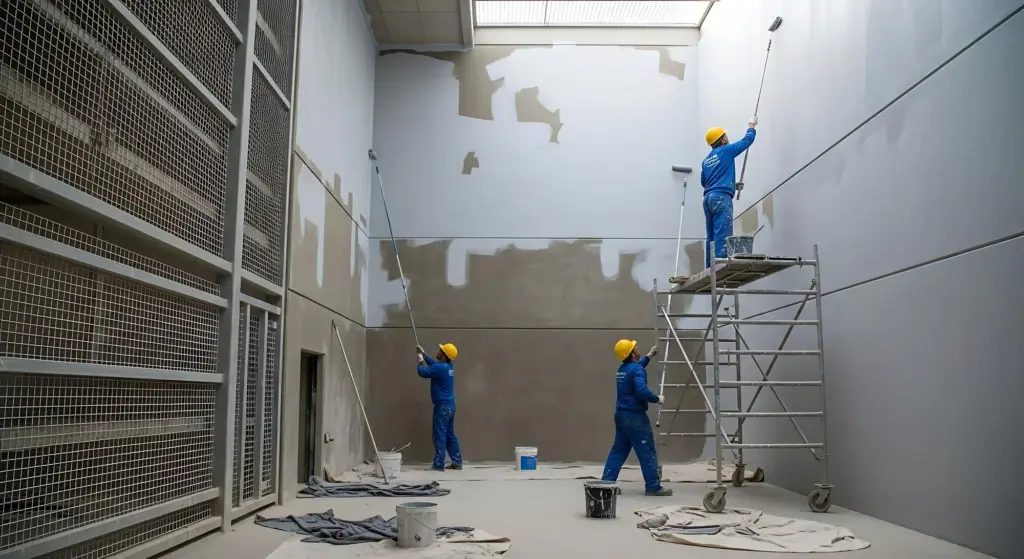
Warehouse painting estimates vary because contractors prepare an estimate based on the actual work involved, not just the building’s floor area. Surface condition, paintable square footage, coating requirements, ceiling height, labor rates, and operating schedules all influence your final cost. Understanding these factors helps you assess pricing accurately and anticipate expenses before requesting contractor bids.
1. Warehouse size and total paintable square footage
A 30,000-square-foot warehouse does not automatically cost twice as much to paint as a 15,000-square-foot facility. Most painting contractors across the US account for mobilization, equipment delivery, project scale, and crew setup. When you have multiple facilities within the same area, combining their painting schedules can help you reduce duplicated setup expenses. For example, hiring one contractor to paint two nearby 10,000-square-foot warehouses in a single project is more economical than commissioning two separate jobs.
Another aspect you have to consider is that most contractors charge for the surfaces they coat, not simply the warehouse’s floor area. A 100×200-foot warehouse with 25-foot walls has 15,000 square feet of gross wall space. After you deduct 1,000 square feet for doors and openings, you have 14,000 square feet of paintable surface. If the per-square-foot rate is $2.50, the painting job will need an investment of $35,000.
2. Surface condition and preparation requirements
Fresh paint will not fix a warehouse wall that is already peeling, a steel column covered in rust, or a concrete floor contaminated with oil. These problems need attention before the contractor opens the paint containers. Otherwise, the new coating can fail prematurely, leaving you with another repair bill. The extent of preparation depends on the damage, but these activities can add the following indicative costs to your estimate:
- Pressure washing and degreasing: $0.15 to $0.50 per sq ft to remove accumulated dust, grease, and warehouse residue, particularly around loading docks and machinery
- Scraping and sanding: $0.30 to $0.80 per sq ft to remove loose paint and prepare deteriorating walls for fresh coatings
- Patching and minor repairs: $0.50 to $2.00 per sq ft to address damaged drywall, cracks, and surface imperfections
- Rust removal: $1 to $3 per sq ft for mechanically preparing corroded steel columns, beams, and metal structures
- Concrete grinding: $0.50 to $2.00 per sq ft to remove failing floor coatings and prepare concrete for epoxy application
3. Type of paint and industrial coatings

Choosing the cheapest paint for your warehouse can turn into an expensive decision if it fails to withstand the conditions inside your facility. If you are unsure whether your facility qualifies as a commercial or industrial project, read our comparison of the difference between commercial and industrial painting. A wall coating exposed to dust and frequent cleaning will have completely different requirements from a concrete floor exposed to forklift traffic, chemical spills, and constant abrasion. The coating specification affects your material costs, application labor, and the number of coats required. Depending on the product and performance requirements, you can budget for:
- Standard commercial acrylic paint: $0.50 to $1.50 per sq ft for materials and application on suitable interior walls
- High-performance washable coatings: $1 to $2.50 per sq ft for walls requiring better resistance to frequent cleaning and surface wear
- Industrial epoxy coating: $2 to $5 per sq ft for concrete floors requiring chemical and abrasion resistance
- Polyurethane coatings: $3 to $7 per sq ft for applications requiring additional chemical, impact, or UV resistance
- Anti-corrosion coatings: $2 to $6 per sq ft for protecting exposed steel structures against rust and environmental deterioration
4. Areas being painted
Painting warehouse walls is not the same job as coating concrete floors or protecting exposed steel beams. Each surface requires a different coating system, preparation method, and application technique. Ordinary commercial wall paint will not withstand forklift traffic on a warehouse floor. Structural steel needs suitable corrosion protection, while overhead ceilings require additional access equipment and careful application around sprinkler systems, lighting, and HVAC ducts. The more surface types you include, the more varied your contractor’s material and labor requirements become.
Consider a facility with 12,000 square feet of walls, 8,000 square feet of concrete flooring, and 2,000 square feet of exposed steel. At installed rates of $2.50, $5, and $4 per square foot, respectively, the combined estimate reaches $70,000. Separating these areas in your contractor’s proposal helps you understand exactly where the budget goes.
5. Ceiling height and specialized access equipment
A warehouse with 35-foot ceilings presents a different painting challenge from one with 12-foot walls. Once contractors need to reach roof decks, overhead beams, sprinkler lines, and upper wall sections, ladders are no longer practical. They have to bring in scissor lifts or boom lifts, depending on the working height, floor conditions, and obstacles. This adds rental, delivery, and equipment-handling expenses to your estimate.
For example, a 26-foot electric scissor lift can cost approximately $150 to $270 per day in many US markets, while larger boom lifts can cost several hundred dollars daily. If your contractor needs a lift for 10 working days, rental alone can add $1,500 to $2,700 or more, excluding delivery. Racking systems and narrow aisles can further increase equipment repositioning time. If you are also planning a shelving upgrade, read how commercial shelving improves warehouse efficiency.
6. Labor rates and local market conditions
Labor is a substantial part of your warehouse painting estimate, especially when the project involves:
- Surface repairs
- Industrial coatings
- Overhead structures
- Detailed application around machinery
Contractors calculate crew hours, painter experience, supervision, and productivity rather than simply counting the number of workers. For example, if a project requires 400 labor hours at an illustrative billing rate of $65 per hour, labor accounts for $26,000. At $85 per hour, the same workload costs $34,000. Consider after-hours and specialty coating work, and the rates will climb much higher.
Your location also changes what contractors charge. Commercial painting markets in California and the Northeast generally face higher labor and operating expenses than many Southern markets. For example, the rates of commercial painting (Author: verify URL – link to commercial painting service page) labor are around $65 to $95 per hour in the Los Angeles market, compared with approximately $50 to $75 in the Dallas market. On a 300-hour project, those ranges translate into a potential $4,500 to $12,000 difference in labor billing.
7. Warehouse operations and scheduling requirements
Painting an active warehouse means working around incoming trucks, forklift routes, inventory movement, and daily order fulfillment. If contractors cannot close entire aisles or loading docks, they will have to divide the project into smaller work zones, protect stored goods, and repeatedly move equipment. This increases setup time and labor costs. For example, painting a 10,000-square-foot picking area in sections while keeping adjacent aisles operational will require several separate work shifts instead of one continuous application.
Your operating schedule matters too. If painting can only happen overnight or on weekends, expect additional labor premiums. Facilities handling food, pharmaceuticals, or temperature-sensitive inventory may also need stricter containment and ventilation arrangements.
Warehouse Painting Cost Breakdown: Where Does Your Money Go?
Your warehouse painting quote covers more than paint and labor. Mobilization, material quantities, equipment delivery, payment terms, and unexpected repairs all affect the final invoice. Here is where the money goes.
- Fixed price vs. time and materials. With fixed-price contracts, you agree on a total for a defined scope (e.g., painting 15,000 square feet of interior walls). Under time-and-materials billing, the final invoice grows with every additional labor hour and gallon of paint. If your warehouse has hidden surface damage, time-and-materials arrangements become substantially more expensive. Ask for a detailed scope, estimated hours, and written pricing for additional work before signing.
- Material quantities and wastage. A 10,000-square-foot surface requiring two coats needs approximately 67 gallons if the coating covers 300 square feet per gallon per coat. Actual consumption increases with surface porosity and application losses. Ask contractors to disclose expected coverage, coat requirements, and wastage allowances rather than accepting an unexplained lump-sum material charge.
- Mobilization and site setup. Crews must transport spray equipment, lifts, scaffolding, compressors, and protective materials to your warehouse before work begins. If your facility is outside the contractor’s regular service area, transportation adds to the estimate. When painting multiple buildings, check whether mobilization is charged once or separately for each building and phase.
- Permits and compliance. Projects involving elevated steel structures or hazardous existing coatings require site-specific safety plans, worker training, fall protection, and respiratory protection. Lead-containing coatings introduce additional testing, containment, and disposal expenses. These requirements must appear in the proposal, not emerge as unexplained charges after work starts.
- Change orders. Hidden damage (peeling paint, corrosion beneath existing coatings) discovered during preparation creates change orders. Ask for an itemized breakdown covering additional square footage, labor rate, materials, and completion time. Never approve verbal additions without written pricing.
- Taxes and payment terms. A $60,000 proposal is not the final amount once sales or use taxes apply. Payment schedules matter too: a 20% deposit on a $60,000 contract means committing $12,000 before work begins. Check cancellation charges, late-payment penalties, retainage, and whether material purchases are included in the deposit.
- Contingency budget. Reserve 5% to 10% of the contract value for unforeseen expenses. For a $60,000 project, that means keeping $3,000 to $6,000 available. This reserve should not become an automatic contractor allowance. Require supporting photographs and written approval before releasing contingency funds.
How Do OSHA Compliance And Safety Requirements Affect Warehouse Painting Costs?

OSHA compliance will affect your warehouse painting quote through specific expenses, and not as a separate government compliance fee. Take a project requiring two weeks of elevated painting work, for example. A 26-foot electric scissor lift can cost around $400 to $550 per week. Now add delivery and collection, usually $150 to $250 each way, and one lift will end up adding approximately $700 to $1,050 before other safety expenses are considered. Two lifts will further push the equipment allowance expense to $1,400+.
Your contractor will also need trained, authorized lift operators, appropriate fall protection, and equipment inspections. If aisle access is restricted while painting overhead surfaces, crews will have to work on additional setup and relocation time. For example, two workers spending two extra hours per shift repositioning barriers and protecting an active loading area over 10 shifts will add 40 labor hours. If the hourly labor rate is $65, this will automatically add another $2,600 to your invoice.
Older warehouses can face a much larger cost increase if existing paint contains lead. Testing, containment, specialized removal, worker protection, and hazardous waste disposal need to be priced according to the actual findings and applicable requirements.
How To Compare Warehouse Painting Contractor Quotes?
Two contractors can quote $38,000 and $52,000 for the same warehouse. The lower price does not automatically mean better value. One proposal might include surface preparation, lift rentals, two coating applications, and after-hours work, while the other excludes several of these expenses. You need to compare the actual work being promised, not just the final figures. For a deeper hiring checklist, see our guide on how to choose a commercial painting contractor in Seattle. Use these checks before choosing a contractor:
- Match the paintable area: Check whether both contractors have calculated the same wall, ceiling, steel, and floor areas. A quote based on 12,000 square feet is not comparable with one covering 16,000 square feet.
- Compare preparation work: Check whether scraping, pressure washing, rust removal, concrete grinding, and crack repairs are included. If one contractor excludes $6,000 in surface preparation, its lower quote is misleading.
- Verify coating specifications: Compare manufacturer, product grade, coverage rate, number of coats, and expected dry-film thickness. Two quotes for industrial floor coatings are not equivalent if one specifies a heavier-duty system.
- Check equipment and access charges: Confirm whether scissor lifts, boom lifts, scaffolding, delivery, and equipment rental are included or billed separately.
- Examine warranty coverage: Compare the warranty period, exclusions, adhesion-failure coverage, and responsibility for repair labor and materials.
- Request a complete payment breakdown: Check deposits, progress payments, taxes, change-order rates, and final payment conditions. Make sure the quoted amount reflects the full agreed scope.
How To Reduce Warehouse Painting Costs Without Compromising Quality?

Cutting your warehouse painting budget does not mean choosing cheaper paint or asking contractors to finish faster. The bigger savings come from reducing repeat work, avoiding unnecessary equipment hours, and preparing the project properly before the crew arrives. For example, coordinating painting with scheduled inventory relocation can eliminate repeated aisle closures and reduce labor spent moving equipment and protecting stock. These practical adjustments help control your final invoice without sacrificing coating performance.
- Combine painting work across multiple areas: If your warehouse has separate storage bays, loading zones, and maintenance rooms, schedule them under one painting contract to reduce repeated mobilization, equipment delivery, and setup charges.
- Complete minor repairs before the painting crew arrives: Address leaking pipes, damaged drywall, and moisture problems beforehand. Otherwise, painters will have to stop their work or submit change orders for repairs outside their scope.
- Schedule painting around inventory movements: Arrange temporary stock relocation during planned maintenance or low-volume periods. Clear access will allow contractors to work continuously instead of spending paid hours waiting for aisles to become accessible for painting.
- Choose coatings based on actual exposure: Reserve chemical-resistant or heavy-duty coatings for areas exposed to chemicals, abrasion, or frequent cleaning. Standard warehouse walls do not need the same coating specification as industrial floors.
- Compare equivalent requirements before approving the quote: Ask whether the contractor can complete elevated sections using fewer lift-rental days through better sequencing. If you can reduce a $250-per-day lift rental by four days, you can save $1,000.
- Avoid unnecessary repainting: Inspect walls and steel structures before approving a full-facility repaint. If only loading-dock walls or high-traffic sections are deteriorating, targeted repainting can defer a large project budget.
Conclusion
Warehouse painting is not just a maintenance expense. It is an investment in protecting your facility, extending surface life, and avoiding repeated repair costs. A cheaper quote that overlooks preparation, coating performance, or operational disruption can reduce your immediate spend but weaken your long-term return. Focus on the total cost of ownership rather than the contractor’s opening price. When you choose the right coating system, control project downtime, and secure workmanship guarantees, you get more value from every dollar invested. The real ROI comes from a warehouse that stays protected longer without demanding another major painting budget ahead of schedule.